Manuals
Sinker weight/Center weight
Explanation of symbols
Important information is labelled with the following symbols:
1 Summary with an overview of the component and key points related to escape protection
1.1 General definitions
| Aquaculture farm | Installation for the farming of fish. |
| Basin dimensions | The pen’s inner circumference. |
| Design working life | Assumed period for which a structure or part of it is to be used for its intended purpose with anticipated maintenance but without major repair being necessary. |
| Operation | Fish farming at site, including all installation and operation activities performed at the site while fish farming is in progress, and that are of relevance to the escape prevention of fish. |
| Extra equipment | Equipment that is not a main component. |
| Inspection | Systematic inspection/examination, usually visual, to ensure that the equipment satisfies the requirements. |
| Pen | Structure whose main function is to provide an enclosure with buoyancy and/or stiffness. |
| Anchoring system | System of lines and bottom attachments with the main function of keeping the aquaculture farm or raft in position. |
| Bridles | Anchoring line between the pen and the anchoring system. |
| Main component | Part of an aquaculture farm that holds one or more of the installation’s load bearing main functions. Example: Pen, anchoring system, raft and enclosure. |
| Enclosure | Net or other system of load bearing parts that form a barrier between the farming volume in a production unit and the surrounding water volume. |
| Bracket | Component keeping the inner and outer floating collar pipes together. |
| Sinker weight | Weight or other device attached to the net to achieve the intended shape. Sinker weight/Centre weight is attached beneath the bottom centre of the net-cone. |
| Cage | Pen with enclosure. |
| NS9415:2021 | Standard which sets out functional requirements for floating aquaculture farms and will be fundamental for stakeholders in the aquaculture industry, such as authorities, supervisory bodies, designers, suppliers, actors within R&D and manufacturers, as well as aquaculture farm owners. |
| NYTEK23 regulation | Governing Regulation for Fish Farming in Norway. |
| Circumference | Inner length of the inner floating collar. |
| Product certificate | Document confirming that the product is manufactured in accordance with the requirements of NYTEK23 and NS9425:2021. |
| Suspension system | Weights, bottom rings or similar to help maintain the three-dimensional shape of the net. |
| Round sling | Endless fibre lifting strap. |
1.2 Introduction
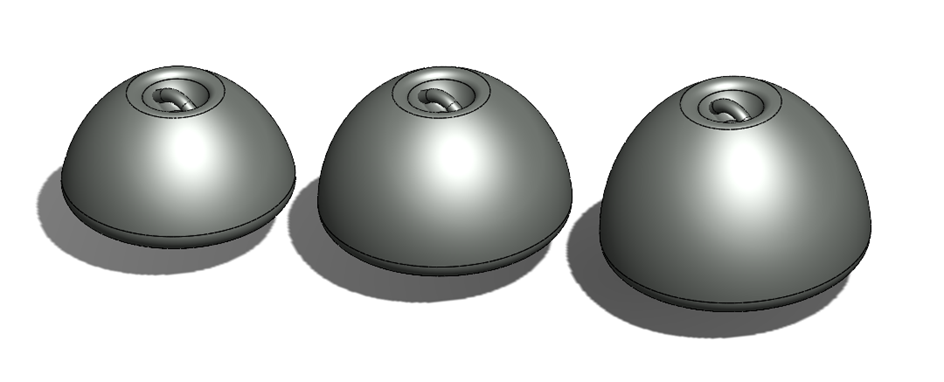
ScaleAQ supplies sinker weights, also known as center weights for ballasting the bottom of the net. These are made of cast iron and are available in several sizes. The most common weights are 500, 750 and 1000kg.
2 Interaction with other components
The sinker weight ensures that the bottom of the net maintains stability. In addition, the weights can be part of the mort handling system where a continuous brailing line is used.
The sinker weight is attached to a rope or round sling that is connected to the center point (gyro) in the bottom of the net. When using a rope, it must be attached directly to the gyro or threaded through the center hole in the gyro and continue to the handrail on the inner part of the net.
3 Mounting the sinker weight/center weight
- When the net is fully assembled, the sinker weight is attached to a specific rope designed for this purpose. The rope runs from the floating collar down to the gyro in the bottom of the net.
- When using a liftup system or a mort removal net with a pulling system, the sinker weight will hang from the gyro.
- When using a mort removal net with a continuous brailing line, the line must run through the gyro and be attached to the bottom of the mort removal net.
- The weight can be positioned as close to the gyro as possible, but make sure it is not in risk of touching the seabed.
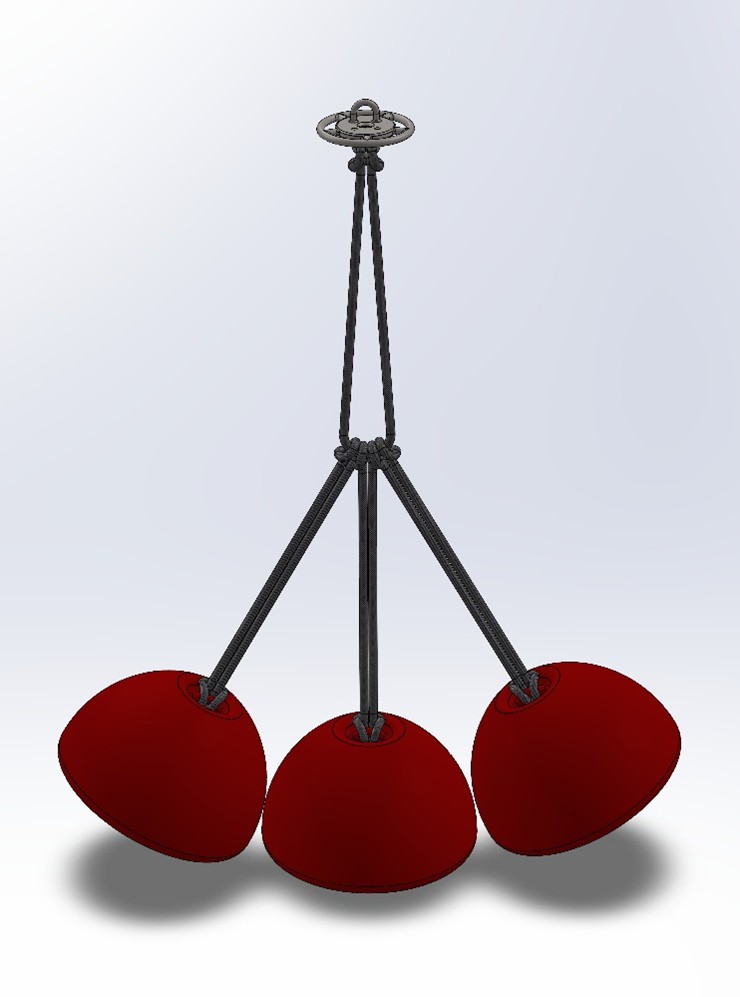
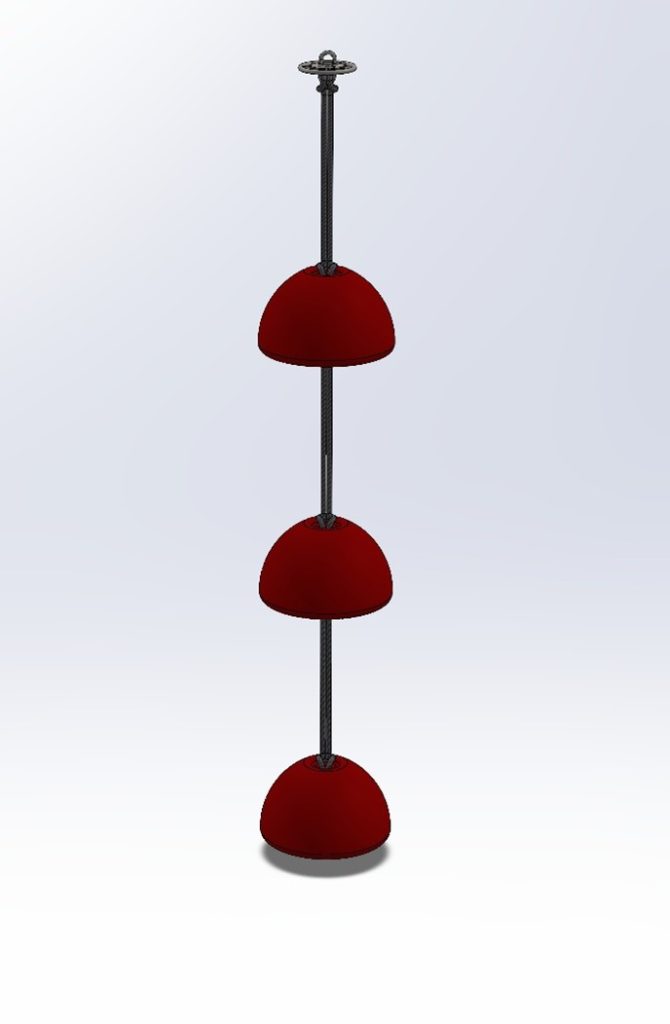
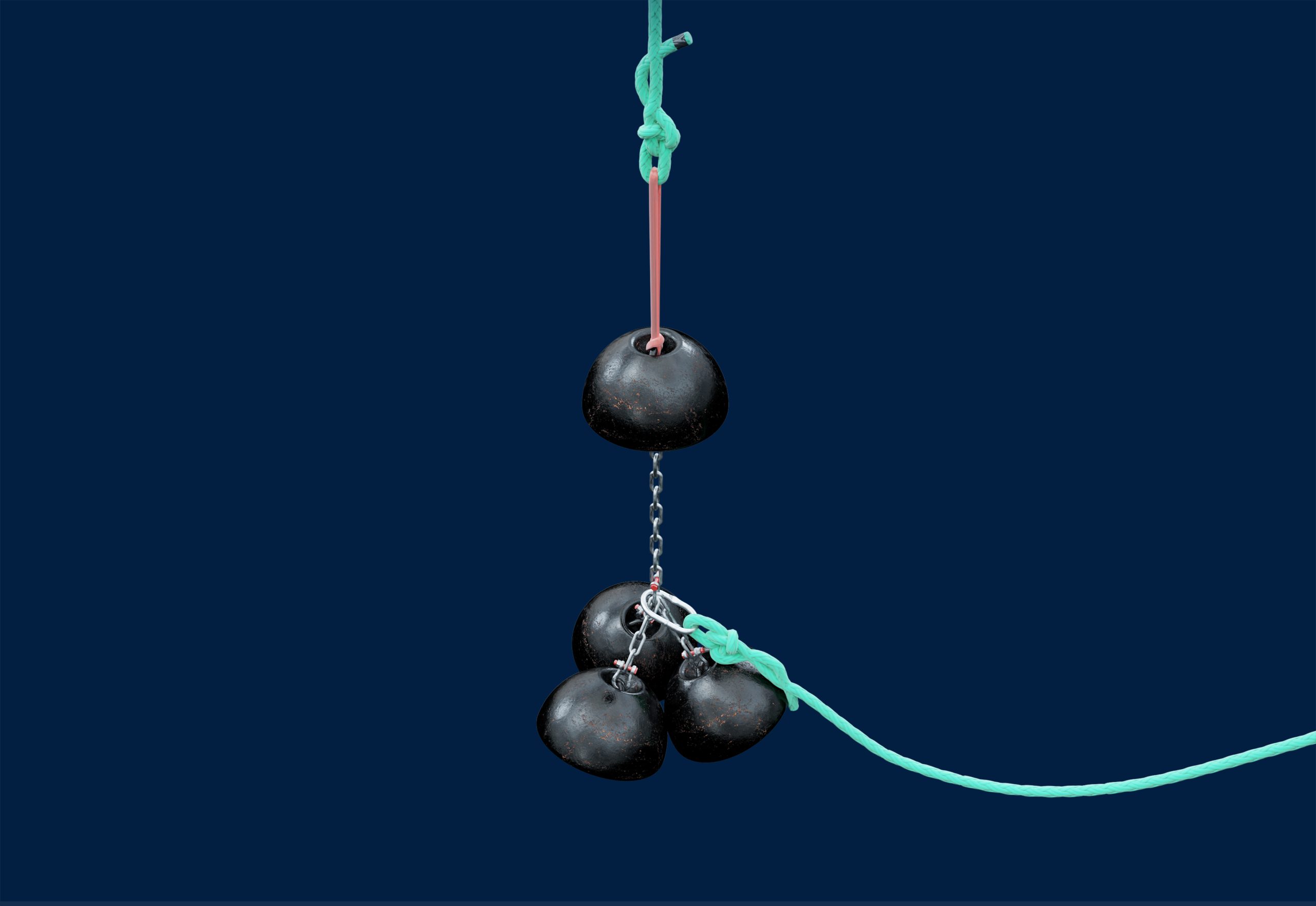
The sinker weight/center weight can be mounted/attached in “lumps” or in series as illustrated in Figure 3.1 and 3.2.
3.1 Approved components for the attachment of sinker weights
3.1.1 Use of round slings
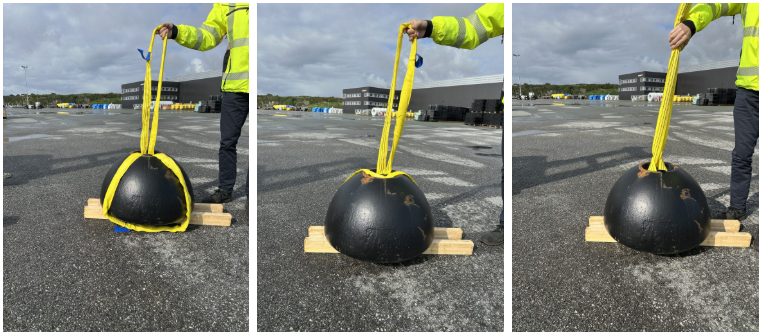
ScaleAQ recommends using a minimum WLL of 3 tonnes of yellow round slings (MBL 16.8 tonnes) between all sinker weights. Round slings are choked at both ends. Start by choking in the gyro, followed by choking to the attachment point at the top of the weight through the attachment ear by threading a loop over the entire weight. See Figure 3.3.
- When several weight are attached in series, the round slings are choked in the same way as described above between all weights.
- When several weights are connected in a “lump”, attach a new round sling to the bottom of the gyro or after the first weight. Then attach the number of round slings (the same number as weights) to this round sling by choking in the same way as described above. The weights are then attached to their respective round slings by choking.
3.1.2 Use of ropes
When using rope for attaching and connecting sinker weights, use a double half hitch with a locking knot at each point. In addition to this, the loose end must be locked in the load-bearing part of the rope. It is recommended to use a minimum of 32mm MBL 16.8 tonnes as shown in Table 2.
Corresponding rope dimensions in the 8-braided variant are also approved for use.
| Item no. | Product name | Meters per coil | MBL |
| 300332 | Rope 32mm 3-strand Aqualine | 110 | 16,8 |
| 300333 | Rope 36mm 3-strand Aqualine | 110 | 20,6 |
| 300334 | Rope 40 mm 3-strand Aqualine | 220 | 25,7 |
3.1.3 Use of shackles and round slings
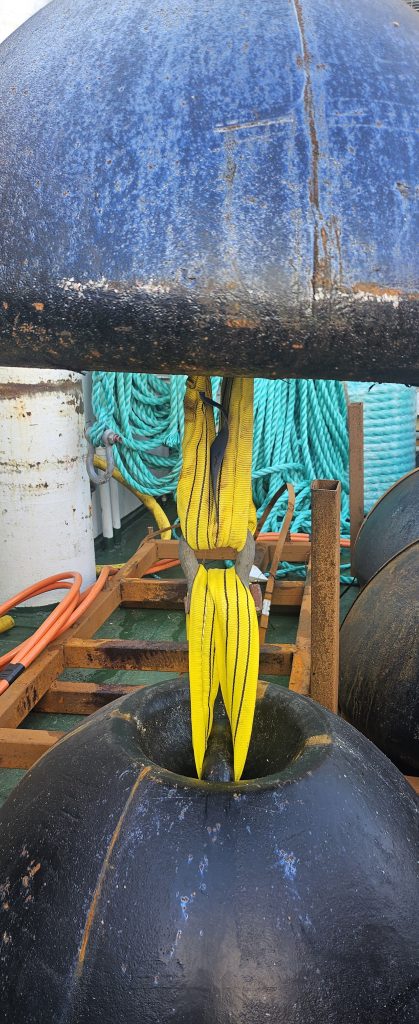
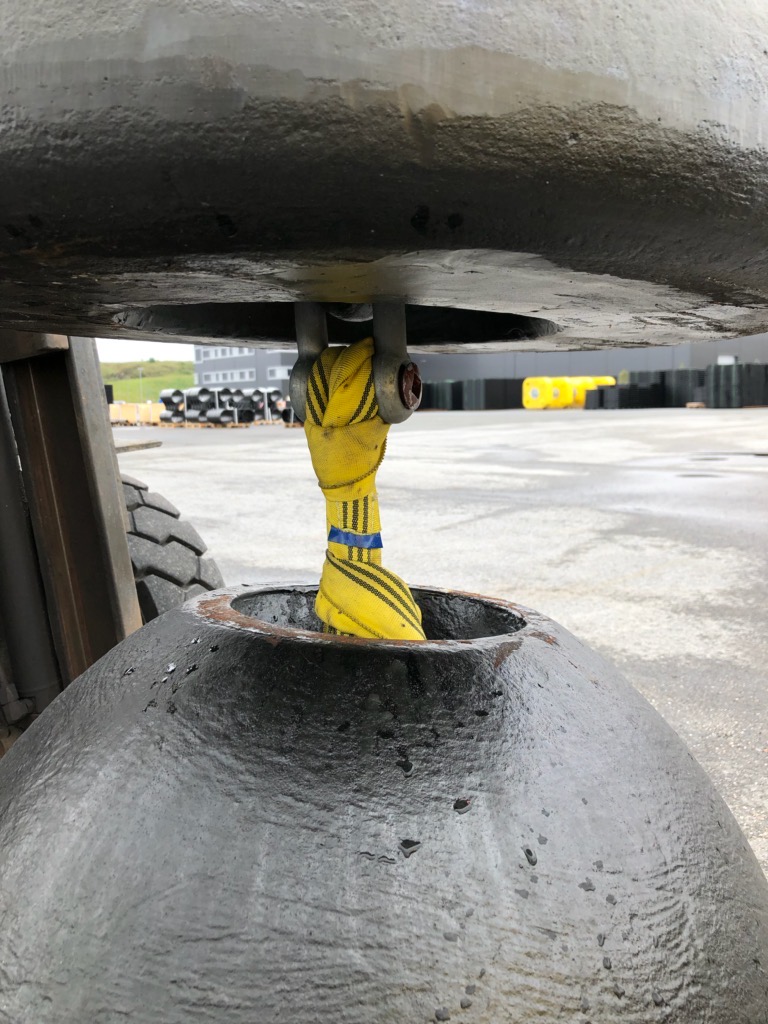
It is approved to use a shackle with double securing minimum MBL 12 tonnes that is secured with loctite either between round slings as shown in Figure 3.4 or directly in the sinker weight as shown in Figure 3.5.
3.1.4 Use of chains
When installing several sinker weights in a “lump” or series, chain can be used as attachment method after the first weight closest to the net. In this case, we recommend using 19 mm long-link chain (galvanized) as illustrated in Figure 3.6. The minimum chain dimension is 16 mm. Note that chains can not be used directly in Gyro!
3.2 Use of sinker weight/center weight in Subsea installation
Sinker weights are installed when the net is in the surface position. The weights are fitted in the same way as in a conventional cage.
If the water is shallower than 110 m below the tip of the net, we recommend raising the sinker tube just below the floating collar during installation to reduce the length of the rope between the top and bottom sinker weights.
See Figure 3.7 for a sketch of Subsea with sinker weight.
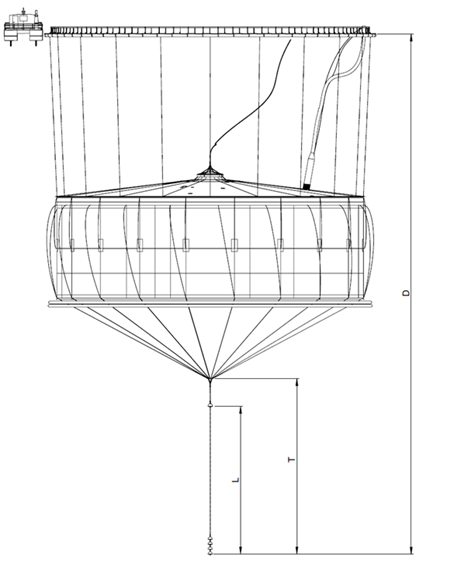
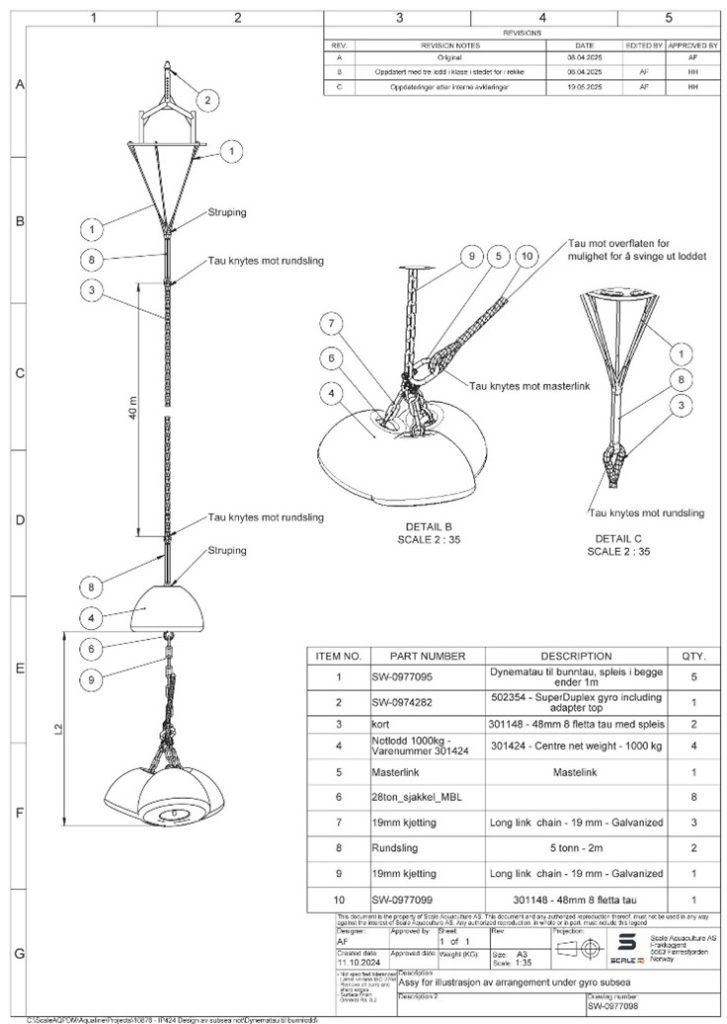
Figure 3.8 shows a detailed drawing of components used in the suspension from gyro to sinker weight on a Subsea installation.
4 Use
- Lifting and lowering the sinker weight must be done in such a way that it does not touch the net or causes any chafing on the net.
- The hauling rope must be used to lift the sinker weight.
- It is important that the net (gyro) carries the load from the sinker weight and not the hauling rope attached to the sinker weight.
5 Inspection and maintenance
Check for chafing and wear, replace components that may pose a risk.
6 Transport and storage
Sinker weights must be secured during transport, indoor storage is preferred.
7 Manufacturer and product identification
The product is designed by ScaleAQ, manufactured to our specifications, labelled with weight and batch number.
8 Revision history
| Rev. | Changes | Date |
|---|---|---|
| 1 | The user manual is designed to meet the new requirements of NS 9415: 2021 | 10.11.2023 |
| 2 | Sketches for attaching sinker weights and the use of round slings as an alternative to ropes are added. | 12.06.2025 |